Machine Learning Algorithms
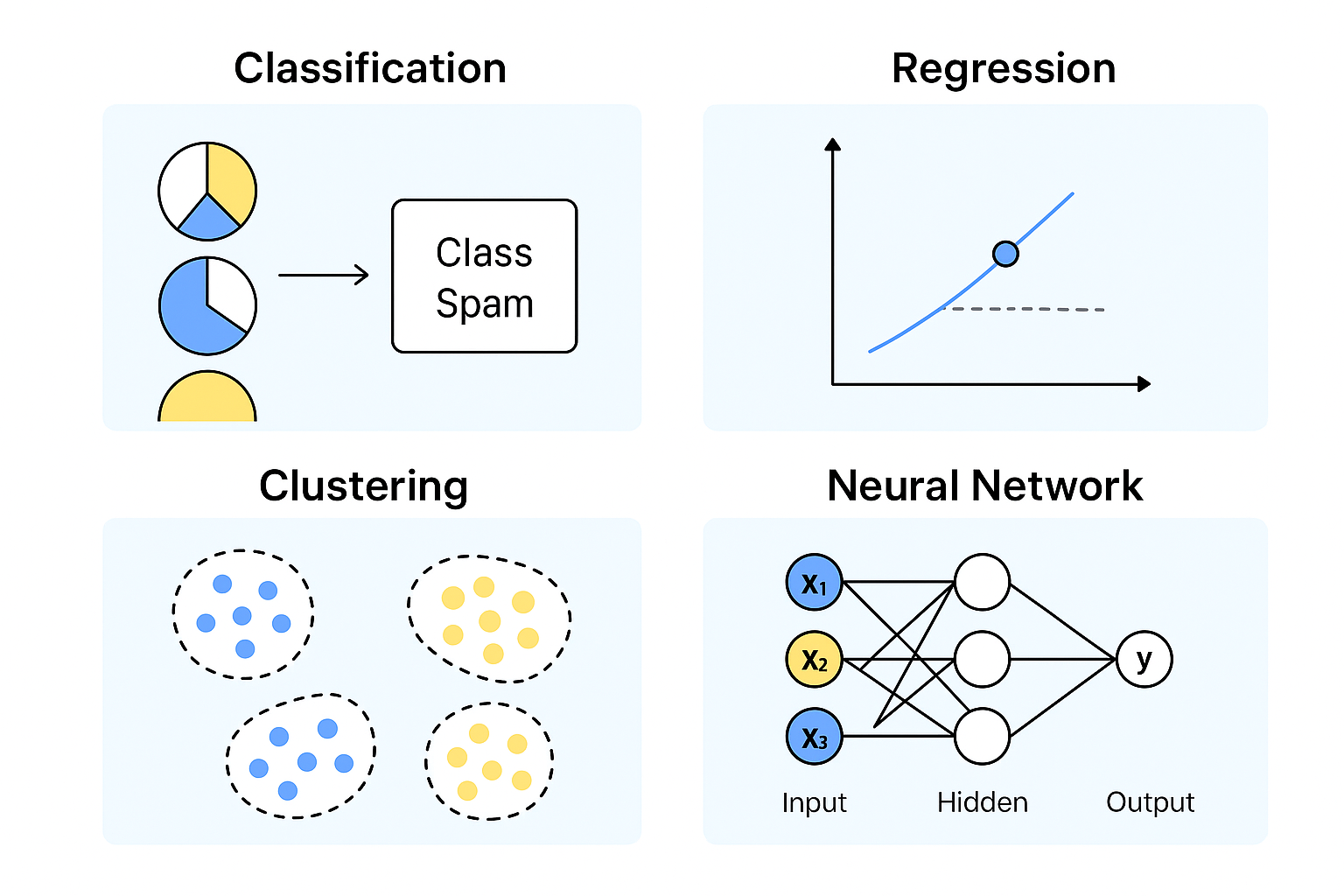
Classification
Goal: Predict a category or class from input data.
How it works:
You give the model examples with known labels.
It learns patterns that separate one class from another.
When given new data, it predicts the most likely class.
Types:
Binary classification: Only 2 classes (spam / not spam).
Multi-class classification: More than 2 classes (cat / dog / rabbit).
Examples:
Email spam filter.
Diagnosing a medical condition (disease present / absent).
Regression
Goal: Predict a continuous number instead of a category.
How it works:
The model finds a mathematical relationship between input features and the output number.
Output can be any real value, not just fixed options.
Examples:
Predicting house prices from size, location, and age.
Forecasting tomorrow’s temperature.
Clustering
Goal: Group similar things together without telling the model the groups beforehand.
How it works:
It looks for patterns or similarities in the data.
Points that are more similar get grouped into the same “cluster.”
Examples:
Grouping customers into buying-behavior segments.
Organizing similar news articles.
Neural Network
Goal: Learn complex patterns using a network of connected nodes called neurons.
How it works:
Neurons are arranged in layers:
Input layer: Receives data (e.g., pixel values from an image).
Hidden layers: Transform the data using mathematical operations.
Output layer: Produces the prediction.
Each connection has a weight (importance), which is adjusted during training to improve accuracy.
Why use it:
Can handle very complex data like images, speech, and natural language.
Examples:
Face recognition in social media apps.
Voice assistants like Alexa/Siri.
Decision Trees
Think of a decision tree like a flowchart or a series of yes/no questions that help you make a decision.
At the top, you start with one big question.
Depending on the answer, you go down a branch to the next question.
You keep going until you reach a final decision (leaf node).
Example:
If you’re deciding whether to play outside:
Is it raining? → Yes → Stay inside.
Is it raining? → No → Is it hot? → Yes → Wear a cap; No → Go outside as you are.
In ML, decision trees split data based on the most important features to predict an outcome.
Linear Regression
Linear regression is about finding a straight-line relationship between inputs and an output.
It assumes that as one thing changes, the other changes in a predictable way.
The “line” is the best fit through the data points.
Example:
Predicting house prices based on size:
Bigger houses usually cost more, so the line goes up as size increases.
The model learns that relationship so it can estimate prices for new house sizes.
Visual Explanation